An ayahuasca retreat can sometimes become difficult
There are moments that are rarely talked about.
Not because they are rare.
But because they are difficult to cross.
Someone is retiring.
She is getting ready.
It opens.
And then, something doesn't go as planned.
Not as imagined.
Not as expected.
When does the experience become uncomfortable?
Sometimes, it starts in a ceremony.
The body tightens.
The mind is racing.
Emotions are resurfacing.
Sometimes, it is more subtle.
A confusion.
Unusual fatigue.
A difficult-to-explain unease.
And a recurring question:
“Is something wrong?”
What is called a difficult experience
A difficult ayahuasca retreat does not mean the experience is negative.
It can take different forms:
- an intense fear
- a loss of bearings
- a strong emotional surge
- a feeling of blockage
- or on the contrary… a disconcerting emptiness
What is difficult, often, is not what happens.
It is not understanding.
Why some retreats are more intense
Each person arrives with a different story.
Some wear:
- a more emotionally charged experience
- old wounds
- family or transgenerational dynamics
- an overactive mind
- a deeper sensitivity
Sometimes, certain people also speak of a subtler, older weight.
In those cases, the work can be more intense.
Not because something isn't working.
But because more material is emerging.
That is why preparation is essential:
→ Preparing for an ayahuasca retreat: diet, treatments and precautions
Ceremonies are not an end in themselves
In the Amazonian tradition, ceremonies are not a goal.
They open.
They reveal.
They set in motion.
But they don't summarize the work.
An intense experience does not guarantee a profound transformation.
And a difficult experience does not mean that something is going wrong.
The role of master plant diets
The work is part of a broader process, notably through Amazonian master plant diets.
These diets allow:
- progressive work
- a more grounded transformation
- a direct relationship with the plant
- an integration over time
This is often where the deepest processes develop.
The dieta is the privileged traditional setting for entering into a relationship with a master plant. It generally involves withdrawal into a simple space in the jungle, often called tambo, far away from external stimuli.
This withdrawal period is accompanied by a very modest diet, precise rules, and a slow pace. It fosters attention to dreams, sensations, and internal movements.
Support: what truly makes the difference
In an ayahuasca retreat, it’s not just the experience that matters.
It is also the way she is supported.
In difficult times, a person should not be left alone with:
- his thoughts
- his overthinking
- her emotions
- his misunderstandings
But this support does not only come through words.
It also relies on concrete materials:
- writing times
- personal creation spaces
- adapted educational tools
These supports allow:
- to set down what cannot be expressed
- to experience emotions differently
- to ease certain more intense phases
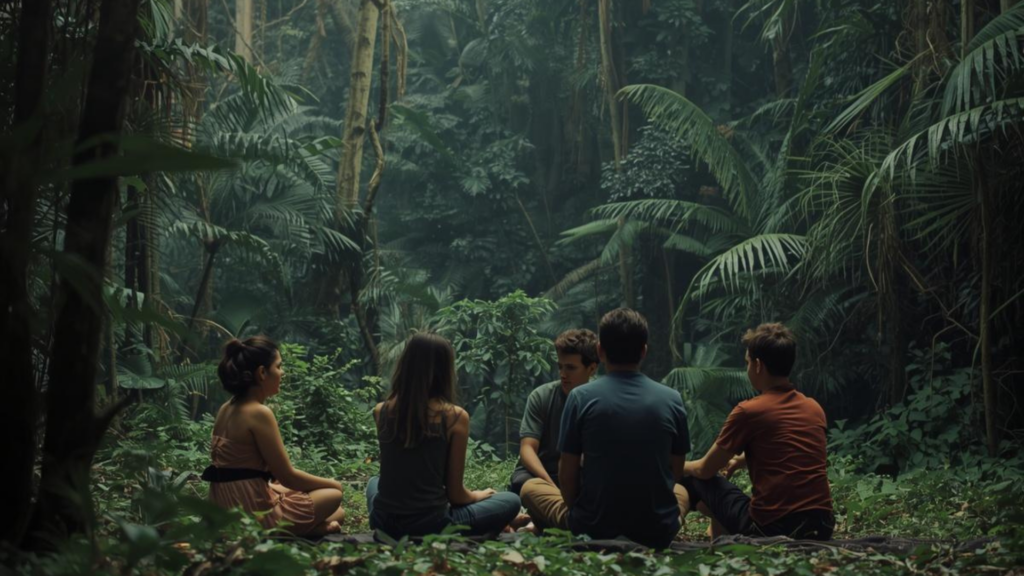
Group sharing sessions
Following the ceremonies, times for sharing are offered.
They allow:
- to express what was experienced
- to recount feelings
- to release certain tensions
- to hear other experiences
These moments help to avoid staying isolated in the experience.
Post-retirement integration
Work does not stop at the end of retirement.
The return can be:
- destabilizing
- intense
- questionnaire
Post-retirement support enables:
- to integrate the experiences
- to understand what has emerged
- to adjust one's daily life
After a difficult retirement: not staying alone
When the experience has been particularly difficult, it is essential not to remain alone.
Personal liability appears:
- contact the center team again
- express what one is going through
- request support
If this support is not sufficient, it is important to seek outside help.
Platforms exist to support these processes.
For example: https://psychedelic.support/
These structures enable:
- remote support
- psychological support
- secure integration
An often misunderstood reality
Some people experience extremely difficult retirements.
And sometimes, they do not find the necessary listening.
If you are currently going through a difficult experience after an ayahuasca retreat, it is important not to stay alone.
Being able to talk about it, being listened to, being guided — even from a distance — can profoundly change the way what you are experiencing will integrate.
In such cases, it is essential to turn to organizations capable of providing in-depth support.
À Inti Eco Lodge, we also support people experiencing more intense phases, including after their return.
The support doesn't stop at the experience.
It includes the ability to:
- listen
- understand
- guide
- and sustain over time
What some research also shows
Scientific studies show that the experience with ayahuasca is heavily dependent on context.
She is influenced by:
- the intention
- the frame
- the group
- the support
Study: https://pmc.ncbi.nlm.nih.gov/articles/PMC8233273/
These findings confirm the importance of a serious and structured framework.
The choice of the center changes everything
Not all pensions are created equal.
The setting, the quality of presence, and the support directly influence the experience.
To go deeper:
→ Serious ayahuasca retreat centers in the Amazon: how to choose the right one
And to understand the Amazonian shamanic tradition:
→ Amazonian shamanism: traditions, practices and authentic surroundings
A question to keep with you
A difficult ayahuasca retreat may be an essential step in the process.
In these difficult times:
“What if what I am experiencing were not a problem... but a passage?”
Conclusion
An ayahuasca retreat can sometimes be difficult.
But that does not mean it is negative.
This may simply indicate that a deep process is underway.
And that this process requires:
- time
2. of the framework
3. and fair accompaniment
Go further
If you feel the need to be supported, to ask questions, or to express what you are going through:
>> Contact us
 French
  English
  Spanish